
The 10,000 Steps Myth — And What You Should Actually Be Aiming For
Let me ask you something.
How many times have you looked down at your phone or your watch at the end of the day, seen you've only hit 7,000 steps, and felt like you'd somehow failed?
Yeah. Me too. And I'm a physiotherapist.
So let's talk about where this magical 10,000 steps number actually came from — because I promise you, the answer is going to make you feel a whole lot better about your step count.
Where Did 10,000 Steps Even Come From?
Brace yourself.
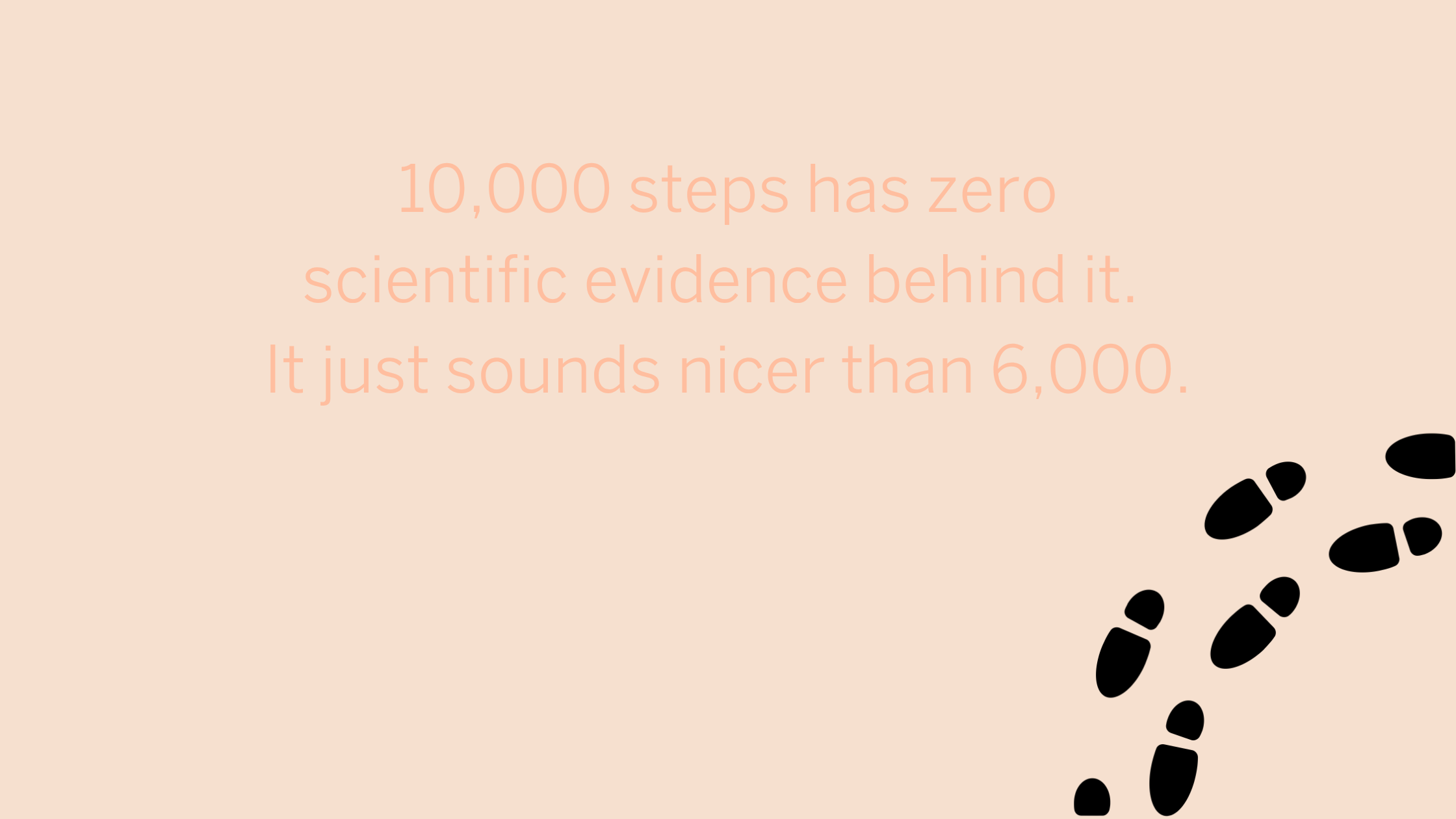
The 10,000 steps target was not born in a research lab. It was not the result of years of rigorous scientific study. It was not handed down by some governing body of health experts who sat around a table and decided that 10,000 was the number that would change the world.
It came from a marketing campaign.
Around the time of the Tokyo Olympics, pedometers were being created and someone needed a catchy, memorable number to put on the box. And here's the thing — 6,000 steps doesn't sound particularly exciting, does it? Neither does 7,500. But 10,000? That sounds like a goal. That sounds like an achievement. That sounds like something worth buying a pedometer for.
So 10,000 it was. And somehow, decades later, we're all still carrying the guilt of not hitting a number that was essentially invented for a sales pitch.

So What Does the Science Actually Say?
Here's what we do know — movement is good. More movement is generally better than less movement. Getting your body moving every single day has real, meaningful benefits for your physical health, your mental health, your pelvic floor, your cardiovascular system — all of it.
But the specific number of 10,000? There is no scientific evidence that this is the magic threshold. None. Research actually suggests that significant health benefits can be achieved at much lower step counts — somewhere around 6,000 to 8,000 steps for many people — with benefits that plateau beyond that point rather than continuing to climb.
Which means that if you're hitting 7,000 steps and feeling like a failure, I need you to stop that right now. 🛑
What Should You Actually Be Aiming For?
Here's my advice, and it's gloriously simple:
Start where you are. Add a little more. Repeat.
If you're currently getting zero steps in intentionally, don't try to go from zero to 10,000 overnight. That's a recipe for sore legs, burnout, and giving up entirely by Wednesday.
Instead — aim for 1,000 more than you're doing today. That's it. Just 1,000 more. Take the stairs instead of the lift. Park a little further away. Walk to the end of the street and back. Small, consistent steps (pun absolutely intended) will get you so much further than an all-or-nothing approach ever will.
And if you ARE hitting 10,000 every day? Brilliant. Keep going. Do more. The point isn't that 10,000 is bad — it's that it shouldn't be the arbitrary stick we beat ourselves with when life gets busy.
The Bottom Line
Movement matters. Consistency matters. Progress matters.
But guilt over a number invented by a pedometer marketing team in the 1960s? That can take a hike. 😄
Start where you are. Move a little more today than you did yesterday. And be kind to yourself along the way — because that's where the real magic happens.
Nicola Robertson, Registered Physiotherapist
Diamond Physiotherapy | Belleville, Ontario
Real talk. Real progress. Real empowerment.